
Key takeaways
- Fixes customer and order records that are incomplete, duplicated or wrong — the addresses that fail delivery and the duplicates that split one customer's history.
- Most failed deliveries are address problems, not courier problems. Verifying before dispatch removes the part you control.
- A one-off clean-up is a fixed-price project; verification at the point of entry is what stops the problem returning.
- Send a representative sample as it actually is — a tidied sample produces a quote that will not survive the real data.
DECK IT, Ahmedabad, verifies and validates e-commerce customer, product and order data across Amazon, Shopify, Magento and other platforms so your marketing and fulfilment run on accurate records. Consumer information is of high value for any business. Gaining access to customer information is a key part of marketing strategy of any business and they procure this information through various sources in eCommerce Data Verification. Capturing and storing information of the customers who approach the e-commerce site is one of the more accurate databases. However, many times, the customers speed through the checkout, which leads to incorrect data. The effort to gain a new customer is more than to retain an existing one. While the quality of the service and the experience offered plays a crucial role in retaining the customer, reaching out to them regularly about the products and services helps in gaining an edge over the competition and preserves the recall value. Hence getting the required contact information of the customer who has visited the e-commerce site becomes crucial. Asking for the information via filling out a form, as part of the check-in or check-out process is a general strategy that is followed. However, most of the customers tend to rush through the process and might even provide incorrect information. Through eCommerce Data Verification, you can accurately capture the customer’s address, email and contact information. When a mistake is made, the software prompts the customer the error type about the information entered, for a speedy resolution and easier exit process. Ensuring accurate and complete information for marketing and promotional purposes is one of the many benefits of the Data Verification process. Its efficacy plays a key role in regular operations, especially with the delivery process. Inaccurate data often results in creating barriers for a smoother delivery process. With real-time customer data verification, the timely delivery of the product shipments can be ensured, as the time spent on interpreting or correcting the shipping information is reduced. E-commerce data verification reduces the strain on the operation and the fulfillment staff by ensuring accurate information is available for decision making. The five flows a manufacturing ERP must cover first, the GST and job-work rules a Gujarat factory faces, and what to leave for later. When a custom hotel PMS beats Cloudbeds or eZee: five-year cost by room count, the four cases that justify a build, and why to keep the channel manager off the shelf. Parking revenue leakage is money a site earns but never records. Here are the five places it goes, the three other things that cause the same shortfall, and the one reconciliation that tells them apart.
eCommerce Data Verification
How does data verification build a complete customer database?


How does verified data improve delivery?
How do I start e-commerce data verification?

Data verification at all points of checkout process

Reduce instances of non-delivery

Timely delivery

Customer satisfaction

Standardized data for analysis
What does DECK IT offer for data verification?

Data verification tools

Data enhancement solution

Behaviour & altitudinal information

Customized database management
Connect with us for a Free Consultation
DECK IT’s engineers look forward to working with you.
Things we've written
ERP for a Manufacturing SME in Gujarat: What to Cover
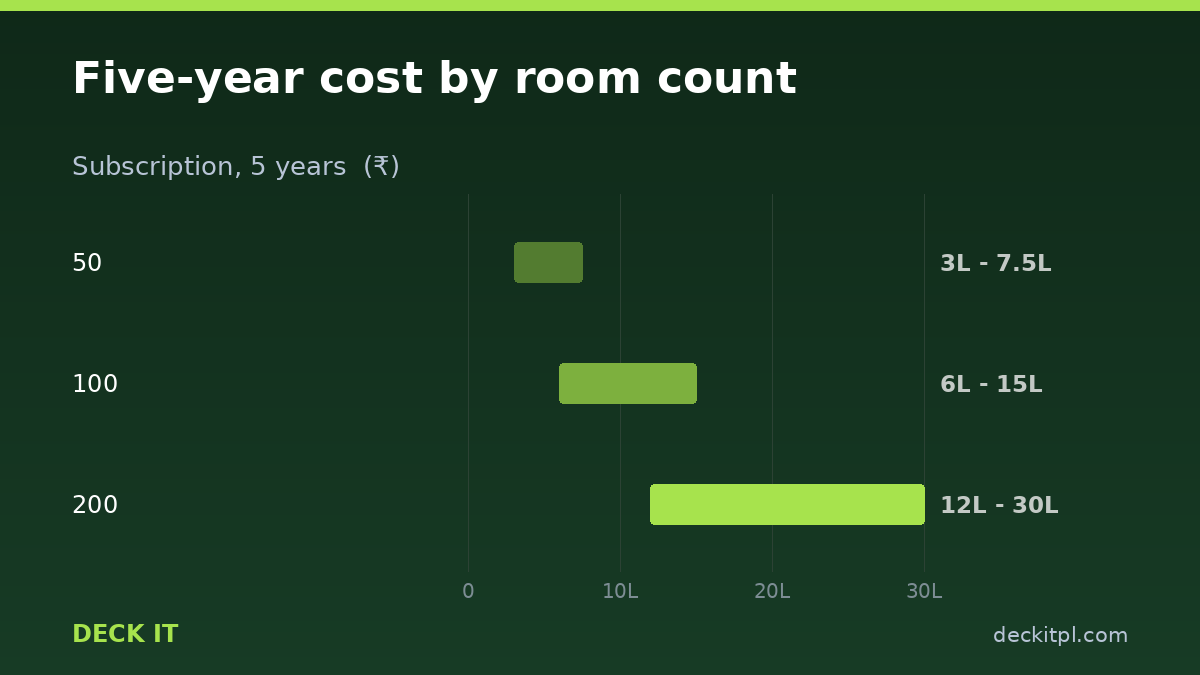
Custom Hotel PMS vs Cloudbeds or eZee: When to Build
Parking Revenue Leakage: Where the Money Actually Goes








Clean up once, or verify at the point of entry?
Both, in that order: a one-off clean-up fixes the records you have, and verification at entry stops the problem returning.
| One-off clean-up | Verification at entry | |
|---|---|---|
| Fixes | Records already in the system | New records as they arrive |
| Shape of work | Fixed-price project, scoped from a sample | A change to the storefront or form |
| Repeat needed | Yes, as data drifts again | No |
| Does it cut failed deliveries | For existing customers | For every new order |
E-commerce data verification: questions we get asked
What does data verification fix?
Customer and order records that are incomplete, duplicated or wrong — the addresses that fail delivery, the duplicate customers that split one person's history, the contact details that bounce. It is a data quality problem, and it shows up as failed deliveries and marketing that misses.
How does it improve delivery success?
Most failed deliveries are address problems rather than courier problems. Verifying and standardising addresses before dispatch removes the part you can control, which is usually the larger part.
Is this a one-off clean-up or ongoing?
Both are sensible. A one-off clean-up of existing records is a fixed-price piece of work; verification at the point of entry is what stops the problem returning, and that is a change to the storefront rather than a data project.
What do you need to quote it?
A representative sample of the records as they actually are. The messy cases determine the approach, so a tidied sample will produce a quote that does not survive contact with the real data.