

Parking Management System
What a parking management system actually includes
| Module | What it does | Who feels the difference |
|---|---|---|
| Entry and exit control | Opens the barrier for a recognised vehicle, pass holder or paid ticket, without a guard deciding | Drivers, who stop queueing |
| Payment | Card, UPI, wallet or prepaid pass at the barrier, kiosk or phone, instead of cash and float | Finance, who stop reconciling a cash box |
| Visitor and pass management | Issues time-limited visitor passes and monthly passes, with their own rules and rates | Reception and residents |
| Vehicle records | Every plate, entry time, exit time and amount against a searchable record | Security, during an incident |
| Tariff engine | Hourly, daily, free-period, peak, resident and exempt rates, changed without a developer | Whoever sets pricing |
| Occupancy and reporting | How full each level is now, and what each site earned this week | Operations and the owner |
Three kinds of operator, three different systems
Where the software meets the hardware
What a deployment involves
- Survey. Lane counts, existing hardware, network coverage at the barrier, where power is. This is where most surprises live, and finding them in week one is considerably cheaper than finding them in month three.
- Tariff and rules configuration. Your actual rates, free periods, validation schemes and exemptions. Usually longer than expected, because the rules people follow in practice are not always the rules written down.
- Hardware integration. Barrier controllers, ANPR cameras, payment terminals.
- Payment gateway. UPI, cards, wallets, and reconciliation against your accounting system.
- Parallel running. The new system records alongside the old process for a cycle, so the numbers can be checked before anyone depends on them.
- Operator training and handover.
What it costs
What we have seen at DECK IT
How do I get started with parking management?

Easy to use solution

Fool proof mechanism

Higher accountability

Customizable solution

Live reports and updates
What does DECK IT offer for parking management?

Customize Space solution

Live Reports

Automated Ticket and Pass Management

Secure Payment and Financial Management

Access control system for designated spaces

Penalty and Violation Management
Connect with us for a Free Consultation





DECK IT’s engineers look forward to working with you.
Things we've written
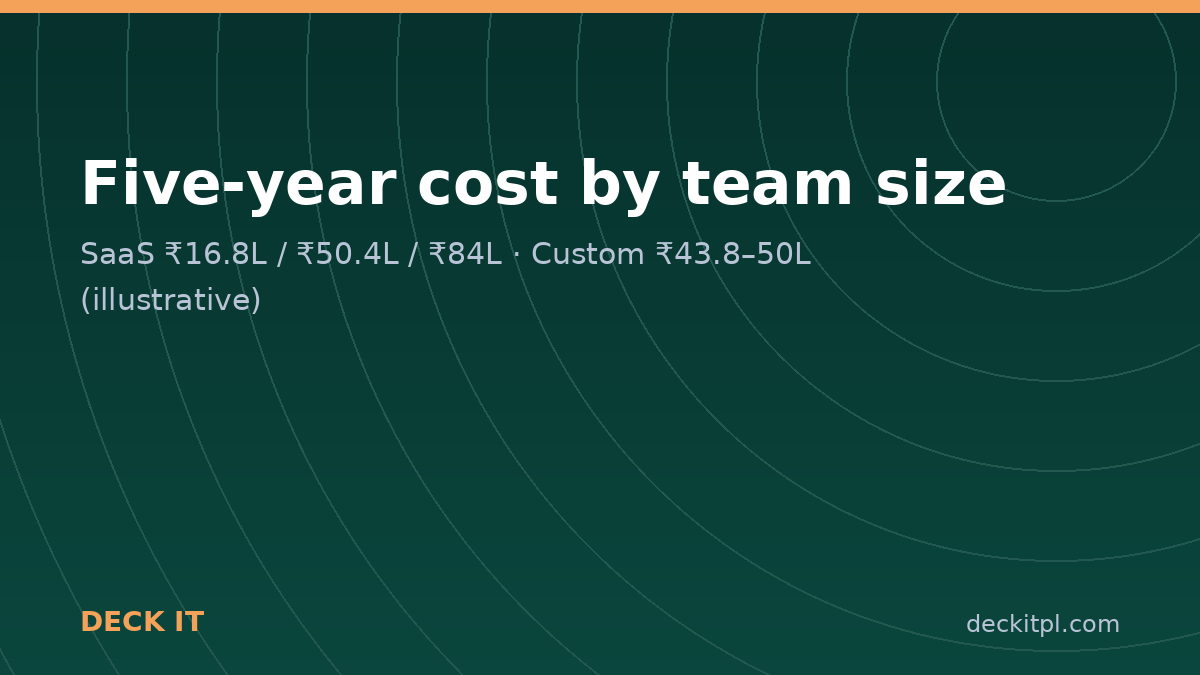
Custom Software vs Off-the-Shelf: How to Choose
When to buy ready-made software and when to build, for Indian SMEs: five decision questions, a five-year break-even with your own numbers, and the hybrid option.
Fleet Management Software Cost in India (2026 Guide)
What fleet software actually costs in India in 2026: per-vehicle subscription bands, GPS hardware prices, whether you need AIS 140 devices, and a worked first-year total for a fifty-vehicle fleet.
Parking Management System Cost in India (2026 Guide)
What a parking system actually costs in India in 2026: barrier and ANPR prices per lane, the three vendor pricing models, what moves the software figure, and a worked first-year total for a three-lane commercial site.
Parking management systems: questions we get asked
What does a parking management system actually do?
It automates entry and exit, payment, visitor passes and vehicle records for a single car park or a whole city parking estate. Manual ticketing and cash handling give way to automated access control and digital payment, which shortens queues at the barrier and gives operators an accurate record of every movement.
How long does a deployment take?
A smart parking deployment usually takes three to five months. That covers barrier and camera integration, payment gateway setup, configuration for your own tariff rules, and operator training. One site moves faster than a multi-location estate. You review working software as it is built rather than waiting for a single handover.
Is it for city administrations or private operators?
Both. DECK IT builds parking systems for city administrations running on-street and public parking, and for commercial and residential operators running their own car parks. The underlying problems match: unmanaged spaces, revenue leakage and congestion at entry. Tariff rules and reporting differ, which is configuration work rather than a separate build.
Can drivers pay without cash?
Yes. Digital payment is standard, so drivers pay without cash at the barrier and operators stop handling float. Cutting manual intervention is the main reason cities invest in parking automation, and payment is usually where the queue forms, so it is the first place automation pays for itself.
What does a parking management system cost?
Most DECK IT projects run between five and forty lakh rupees, roughly six to fifty thousand US dollars. For parking, the number of sites, whether barrier and camera hardware is in scope, and the payment gateways required move the figure most. We scope before quoting, so the price is fixed rather than open-ended.