
Custom Hotel PMS vs Cloudbeds or eZee: When to Build
In a custom hotel PMS vs Cloudbeds or eZee decision, building wins only when your hotel does something a product can't be configured to do, or when you run enough rooms across enough properties that one system has to hold it all. For a single standard hotel of under about 50 rooms, a subscription is cheaper and faster, and we'd tell you to buy it.
That is the honest answer, and this guide shows where the line sits. Below: what the products cost, what a build costs, the five-year arithmetic, and the specific reasons that justify writing your own.
Key takeaways
- One India-focused guide puts mid-tier PMS subscriptions (eZee, Hotelogix, Djubo, Cloudbeds) at about ₹100–₹250 per room per month, and a custom build at ₹8–₹30 lakh upfront plus ₹50,000–₹3 lakh a year in support (CodingClave).
- The same guide says subscriptions win under 50 rooms, custom wins above 80, and a hybrid wins in between (CodingClave).
- Many 2026 custom projects keep an off-the-shelf channel manager and connect to it, which cuts development scope by 15–25% (Kolonell).
- Standard PMS products tend to struggle with consolidated bookings and reporting beyond three or four properties (Kolonell).
What do Cloudbeds and eZee actually cost?
Neither vendor makes pricing easy to pin down, which is part of the problem. Cloudbeds plans are reported by third-party trackers at roughly $108 a month at the entry level, rising through tiers of about $180, $220 and $320, with enterprise pricing on request, and the vendor raised prices in February 2026 (CostBench). Those are dollar figures per property, before a channel manager, payment fees or onboarding.
eZee Absolute does not publish a price at all. Third-party listings disagree wildly, from a few dollars a month to more than $2,000, and one comparison site estimates annual total cost at $1,200–$3,500 or more (ITQlick, GoodFirms). Treat every figure as directional and get a written quote for your room count.
For a fuller breakdown of Indian pricing, see our hotel management system cost guide.
How much does a custom hotel PMS cost?
A custom PMS in India typically costs ₹8–₹30 lakh to build and ₹50,000–₹3 lakh a year to maintain, according to one India guide written by a custom-software firm (CodingClave). That firm sells builds, so read the low end as optimistic.
Build time is the other cost. Estimates for a multi-property custom PMS run 16 to 26 weeks of development, longer once data migration and staff training are added (Kolonell). During that time you are paying for the build and still running on whatever system you have today.
When does building beat buying on cost alone?
On price alone, building rarely wins until you are well past 100 rooms. Using the per-room range above (₹100–₹250 a month) against the build range (₹8–₹30 lakh plus ₹50,000–₹3 lakh a year), the five-year arithmetic looks like this. It is our calculation on one source's ranges, not a quote.
| Rooms | Subscription, 5 years | Custom build, 5 years | Reading |
|---|---|---|---|
| 50 | ₹3 – ₹7.5 lakh | ₹10.5 – ₹45 lakh | Subscription wins clearly |
| 100 | ₹6 – ₹15 lakh | ₹10.5 – ₹45 lakh | Subscription still cheaper in most cases |
| 200 (e.g. 5 properties × 40) | ₹12 – ₹30 lakh | ₹10.5 – ₹45 lakh | Ranges overlap; cost stops deciding |
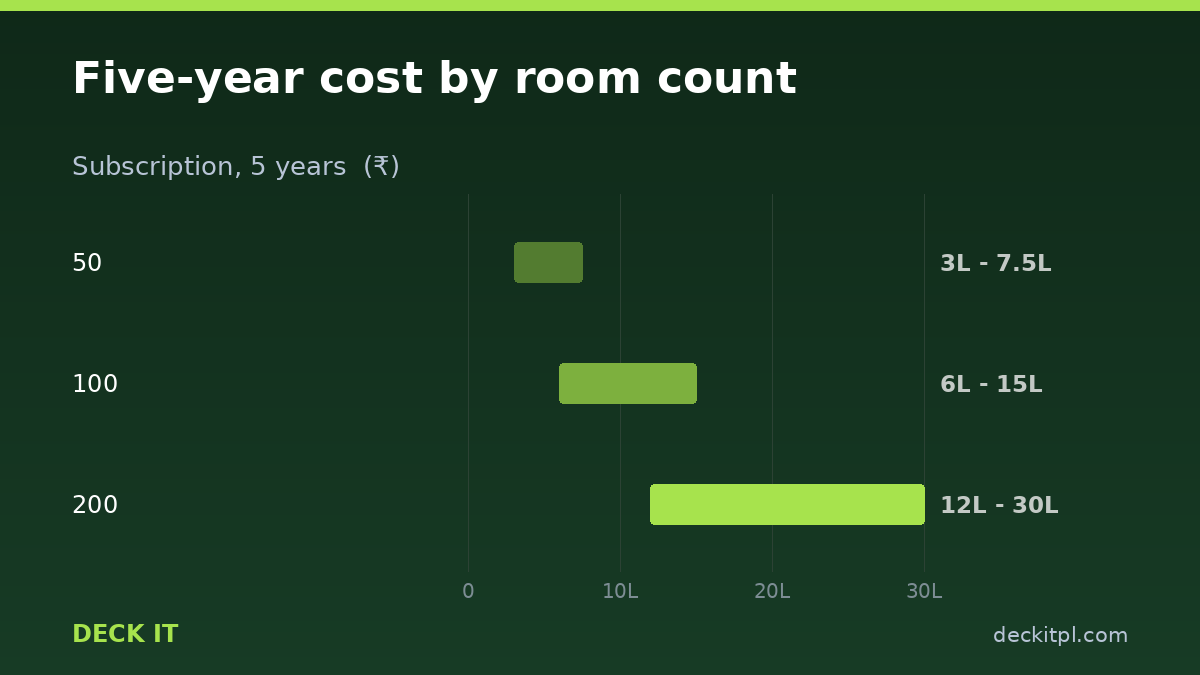
The reading is blunt. Even at 100 rooms, a subscription is usually cheaper. Custom starts to compete on cost only at group scale, and by then other reasons carry more weight than the price.
What are the real reasons to build your own PMS?
Four situations justify a build, and none of them is "the subscription is too expensive".
- Several properties that need one view. A standard PMS struggles to give consolidated bookings and reporting beyond three or four hotels (Kolonell). If your owners or finance team need one dashboard across a group, this is the strongest case.
- A workflow no product models. A resort with several revenue centres, a hotel that sells packages tied to activities or transport, or a property with an unusual approval chain for corporate billing. If you would pay staff to work around the software every day, count that cost.
- Your own systems at the centre. If the PMS must feed an existing ERP, accounting package or loyalty programme in a way the vendor's API doesn't allow, a build or an integration layer may be cheaper than the workaround.
- You want to own the data and the roadmap. Subscription vendors change prices and features on their schedule. A build is yours, though it also makes you responsible for uptime and fixes.
If none of these applies to your hotel, buy.
Should you keep the channel manager off the shelf?
Yes, in almost every case. The channel manager is the part of a hotel stack that connects to Booking.com, Expedia, Agoda and the other OTAs, and those connections are maintained by specialist vendors. Many 2026 custom projects keep an off-the-shelf channel manager and connect it to the new PMS, at an integration cost of $11,000–$22,000, and doing so cuts development scope by 15–25% (Kolonell).
This is the hybrid model that RaftLabs also recommends: buy the commodity pieces, build only where you differentiate (RaftLabs). It also avoids the biggest risk in a custom build, which is a rate or availability error that oversells rooms.
What does a custom PMS have to do on day one?
A build that skips the boring parts fails in the first month. Before you sign a scope, check it covers:
- GST-correct invoices, with e-invoicing if your turnover is above ₹5 crore, and Form C reporting for foreign guests
- Reservations, room inventory, rate plans and housekeeping status
- Night audit and end-of-day reports your accountant accepts
- Role-based access, so front desk staff can't edit closed bills
- Data export in a standard format, so you are not locked in to your own system
- A tested connection to the channel manager and payment gateway you chose
If a vendor's proposal lists features but not these, ask why.
What we've seen at DECK IT
We're DECK IT, a software company based in Ahmedabad since 2017. We build custom software, and we also sell a ready-made hotel product, our Smart Hotel Management Software, which covers check-ins, housekeeping, bookings and billing.
Selling both gives us a straight view of the question. If your hotel runs a fairly standard front desk, a product, ours or a competitor's, is the right answer and we will say so. We take on a custom build when the need is real: a group that needs one system, or a workflow a product cannot be configured to follow. We scope those in two-week cycles so you see working software early, and larger business systems usually take three to five months. Our custom development service starts with a scoping conversation, not a quote.
The general buy-or-build trade-offs are the same in every industry, and we wrote them up in custom software vs off-the-shelf.
Frequently asked questions
Is a custom hotel PMS better than Cloudbeds?
Only if your hotel has needs Cloudbeds can't be configured to meet, such as a group of properties needing one view or an unusual workflow. For a single standard hotel, Cloudbeds or a similar product is cheaper and quicker to start. Cost alone rarely justifies a build.
How many rooms do you need before custom pays off?
One India guide suggests subscriptions win under 50 rooms and custom wins above 80, with a hybrid in between. Our own five-year arithmetic on its ranges says cost only overlaps at roughly 200 rooms, so room count alone isn't the test. Property count and workflow matter more.
How much does a custom hotel PMS cost in India?
A custom hotel PMS in India costs about ₹8–₹30 lakh to build plus ₹50,000–₹3 lakh a year to maintain, according to one custom-software firm's guide. Treat the low end with caution. Scope, integrations and data migration move the number most.
How much does eZee Absolute cost?
eZee does not publish its pricing, and third-party listings disagree widely. One comparison site estimates annual total cost at $1,200–$3,500 or more. Ask eZee for a written quote that names the channel manager, booking engine and payment fees.
Should a custom PMS include its own channel manager?
Usually not. Most custom projects connect an off-the-shelf channel manager, which cuts development scope by 15–25% and avoids the risk of OTA connection errors. Build only the parts that make your hotel different.
How long does a custom hotel PMS take to build?
Estimates run from 16 to 26 weeks of development for a multi-property system, and longer once data migration and staff training are included. Plan to run your current system in parallel until the new one passes a full night audit.
Conclusion
Start by writing down why you'd build. If the reason is price, run the numbers above and buy a subscription. If the reason is a group-wide view, a workflow no product covers, or integration with your own systems, a build, ideally with a bought channel manager, may be the better answer.
If you're weighing it, talk to us. We'll tell you plainly whether your hotel needs a build or a product, and we sell both.