
Custom Software Development Cost in India (2026 Guide)
Custom software development cost in India in 2026 runs from about ₹2 lakh for a small MVP to ₹1 crore or more for a multi-module enterprise platform, and most business applications land between ₹5 lakh and ₹25 lakh. In dollars that is roughly $2,400 to $150,000+, or 40–60% less than the same work costs in the US, UK or Australia. This guide gives you the numbers Indian vendors are actually quoting this year, what pushes a quote up or down, what a ₹10 lakh quote really costs once GST, hosting and support are added, and how AI-assisted development is changing the maths.
Key takeaways
- Indian vendors quote roughly ₹4–8 lakh for a basic MVP, ₹10–25 lakh for a mid-sized business application and ₹25 lakh to ₹1 crore+ for an enterprise platform (Milestone, 2026).
- Hourly rates in 2026: junior $15–25, mid-level $25–45, senior $45–80 (Dotsquares); US rates are $100–150+ (Apptunix).
- Tier-2 cities such as Ahmedabad, Pune and Jaipur are 10–20% cheaper than Bangalore or Mumbai (Acquaint Softtech).
- Build cost is not total cost: budget 15–20% of the build price every year for maintenance (Savi), plus 18% GST and separately billed hosting and integrations (Selyst).
- A poorly scoped project inflates the bill by 40–60% (Selyst). Scope, not hourly rate, is where most money is lost.
How much does custom software development cost in India?
A working business application with a few user roles, an admin panel and one or two integrations typically costs ₹5 lakh to ₹25 lakh in India in 2026. Below that you are buying a single-purpose tool or a stripped-down MVP; above it you are buying an ERP, a multi-tenant SaaS product or something with heavy compliance and integration work.
The ranges below combine the bands published by Indian vendors this year. They overlap because every vendor draws the lines between "simple", "mid" and "enterprise" slightly differently.
| Project type | Typical India price (2026) | USD equivalent | Typical timeline | Source |
|---|---|---|---|---|
| Single-purpose internal tool | ₹2.5–3 lakh upwards | $3,000–4,000 | 6–10 weeks | Mishram Group |
| Basic MVP (one platform, core flows) | ₹4–8 lakh | $5,000–10,000 | 6–10 weeks | Milestone, Rannlab |
| Mid-sized business application (roles, APIs, admin) | ₹10–25 lakh | $12,000–30,000 | 4–7 months | Milestone, ITMTB |
| Multi-tenant SaaS with payments and analytics | ₹12–45 lakh | $15,000–55,000 | 4–7 months | Selyst |
| Custom ERP / CRM | ₹15 lakh – ₹1 crore | $18,000–120,000 | 7–14 months | Mishram Group, BigSun |
| Enterprise platform with AI/ML modules | ₹25 lakh – ₹1 crore+ | $40,000–150,000+ | 7–14 months | Milestone, ITMTB |
Timelines are from Rannlab (MVP 6–10 weeks, mid-sized platform 4–7 months, enterprise 7–14 months). USD figures use roughly ₹83 to the dollar and are rounded.
Two things stand out. First, the "average" figure some pages quote, $20,000 for an MVP up to $500,000+ for a large ERP (CIS), is skewed by projects sold to overseas clients at overseas budgets. Domestic Indian businesses mostly buy in the ₹5–25 lakh band. Second, almost nobody publishes what is inside those numbers, which we get to below.
What is the hourly rate of a software developer in India in 2026?
A mid-level developer at an Indian agency bills $25–45 an hour in 2026; juniors bill $15–25 and seniors $45–80 (Dotsquares). A blended team rate, which is what you actually pay on a project, lands around $18–40 an hour (Mobisoft).
| Who is doing the work | India, per hour | Notes | Source |
|---|---|---|---|
| Freelancer | $8–15 | No replacement guarantee, no structured QA, usually no senior review | Mishram Group |
| Junior developer (0–3 yrs) at an agency | $15–25 | Needs supervision; fine for well-specified tasks | Dotsquares |
| Mid-level (3–7 yrs) | $25–45 | The backbone of most project teams | Dotsquares |
| Senior / architect (7+ yrs) | $45–80 | Design, integrations, reviews | Dotsquares |
| AI/ML or blockchain specialist | $50–130 | Specialised stacks carry a 20–35% premium | Acquaint Softtech, Aalpha |
| Ahmedabad agencies (Clutch, Sep 2026) | $25–49, median $25 | Tier-2 cost base | Clutch |
| US developer, for comparison | $100–150+ | Same seniority | Apptunix |
City changes the number. Vendors in Bangalore and Mumbai carry higher rates than those in Ahmedabad, Pune or Hyderabad because their office and salary costs are higher; tier-2 cities come in 10–20% lower (Acquaint Softtech). Stack changes it too: Laravel or Django work adds 10–15% to a quote because fewer developers specialise in them, and a niche stack like Ruby on Rails or Phoenix adds 20–30% (Selyst).
The freelancer row deserves a caution. $8–15 an hour looks like a third of the agency price, but the gap is mostly things you cannot see on the invoice: nobody to replace the person if they leave mid-project, no tester, no code review. Mishram Group makes the same point, and it matches what we see when a client brings us a half-finished freelancer build.
Why is software development cheaper in India than in the US?
Software costs less in India because developer salaries and office costs are lower, not because the work is worse. Glassdoor puts the average software developer salary in India at ₹7,55,000 a year, with the 25th–75th percentile at ₹4,42,500 to ₹13,87,500 (Glassdoor). The US equivalent is $90,000–150,000, which is why the 60–70% saving on rates reflects cost of living rather than a skill gap (Dotsquares).
The scale of the industry matters too. Nasscom projects India's technology sector at $315 billion in FY2026, up 6.1%, with IT services contributing $149 billion and AI-related revenue at $10–12 billion (Nasscom Strategic Review 2026, via YourStory). IT exports rose 5.58% to $246.4 billion in FY26 through February (IBEF). A workforce of almost 6 million means deep benches in every mainstream stack, which keeps rates competitive.
What actually drives the price up or down?
Scope drives price more than anything else. Every other factor, from stack to security, matters only in proportion to how much of it the scope demands.
- Number of user roles and screens. Each role means its own permissions, views and test cases. A tool with one role and eight screens is a different project from one with four roles and forty.
- Integrations. A single third-party integration (payment gateway, SMS, maps, Tally) adds ₹40,000–70,000; connecting to SAP or Oracle adds ₹2–5 lakh (Selyst).
- Platforms. Web only, or web plus iOS and Android? Cross-platform frameworks cut the mobile premium but do not remove it.
- Design depth. A functional admin UI costs a fraction of a polished consumer product with custom illustrations and animation.
- Security and compliance. Audit trails, role-based access, data-residency and healthcare or payments compliance add design and testing time.
- AI features. Anything with a model in the loop (document extraction, chat, recommendations) needs data work and evaluation on top of normal build effort, and specialists bill at the top of the rate table.
- Vendor process maturity. Structured QA, staging environments and written acceptance criteria cost more up front and save far more later. Only 31% of software projects finish on time and on budget (Standish CHAOS Report via Brainhub); process is the difference.
Fixed price or time and material: which is better?
Fixed price is better when the scope is defined and stable; time and material (T&M) is better when you expect the scope to change as you learn. Fixed price means the vendor commits to scope, timeline and total price before development starts, and builds a risk buffer into the number. T&M means you pay agreed hourly rates for the actual hours worked (ScienceSoft).
| Model | Best for | How you pay | Watch out for |
|---|---|---|---|
| Fixed price | Defined scope, first version of a business tool, budget approvals | Milestones against a written scope | Change requests priced separately; vague scope becomes a dispute |
| Time and material | Evolving products, discovery phases, long-running roadmaps | Monthly, on hours logged | Needs your active governance; cost is open-ended |
| Dedicated team | Ongoing product work with a backlog | Monthly per person; a 3-person India team (2 devs + 1 QA) is $9,000–18,000/month (Eluminous) | You are managing the team; utilisation is your problem |
A staged approach is common and sensible: fixed price for well-defined deliverables, T&M for discovery and technical spikes (Saigon Technology). For most first-time buyers of custom software in India, fixed price against a written scope is the safer contract, because it forces the scoping conversation to happen before money is spent rather than after.
What a ₹10 lakh quote really costs in year one
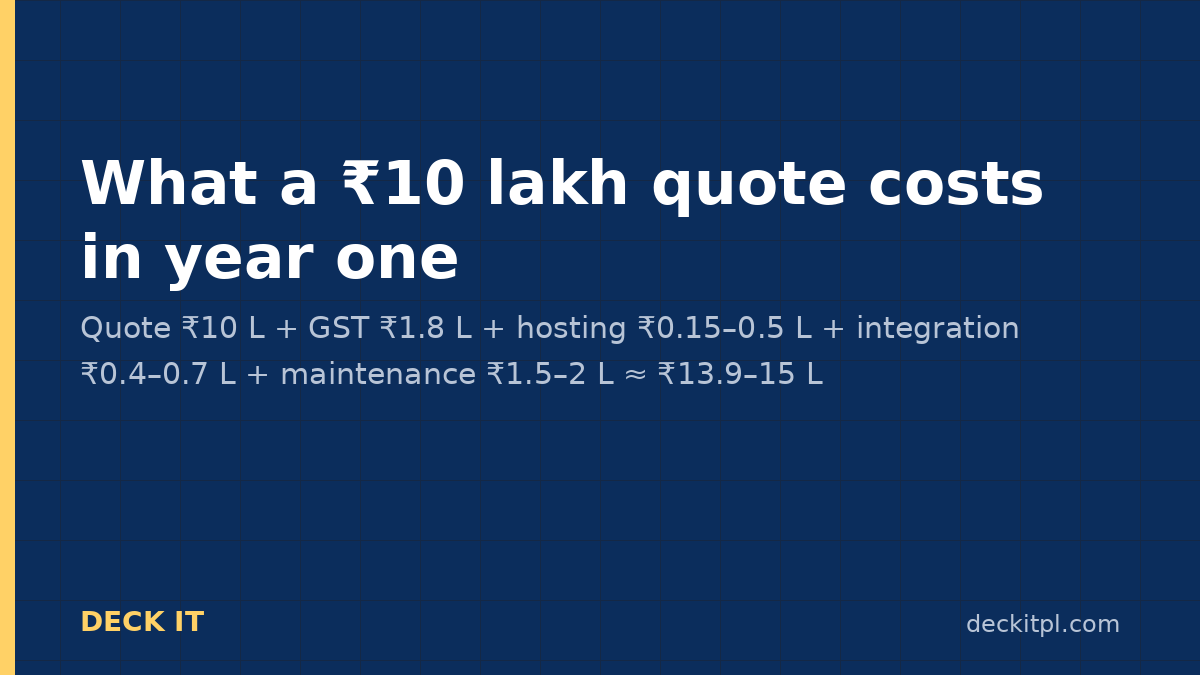
A ₹10 lakh fixed-price quote in India usually becomes ₹13.5–15 lakh by the end of the first year once you add GST, hosting, one integration and maintenance. None of these are hidden if you ask; they are simply not in the headline number, and no cost guide we found shows them together.
| Line item | Amount | Why it is there | Source |
|---|---|---|---|
| Development quote | ₹10,00,000 | The fixed price for the agreed scope | — |
| GST at 18% | ₹1,80,000 | Applies to most software development services in India; quotes are usually ex-GST | Selyst |
| Cloud hosting, domain, SSL (year 1) | ₹15,000–50,000 | Billed separately; AWS India, Azure or Google Cloud for a small app | Selyst |
| One extra third-party integration | ₹40,000–70,000 | Payment gateway, SMS, e-invoicing, Tally sync | Selyst |
| Maintenance and support (year 1) | ₹1,50,000–2,00,000 | 15–20% of build cost per year is the long-standing industry rule | Savi |
| Year-one total | ≈ ₹13.9–15 lakh |
Over the whole life of a system the split gets more lopsided: about 60% of total software cost is spent after launch and only 40% on the initial build (Pegotec). Large, heavily integrated enterprise systems can need 20–30% of the build cost a year (Intigate).
So when you compare two quotes, compare year-one totals, and ask each vendor to state in writing what "support" includes: bug fixes only, or also small enhancements, OS and library upgrades, and monitoring.
Does AI-assisted development make custom software cheaper?
AI-assisted development makes custom software faster to build and somewhat cheaper, but it does not shrink every line of the quote equally. A GoodFirms survey found 91% of software companies now use AI to cut development costs (GoodFirms via Yahoo Finance). McKinsey measured 33–36% reductions in code-related time at scale, and controlled experiments have shown developers finishing tasks up to 55% faster with an AI assistant (Value Add VC's summary of METR, McKinsey and GitHub data).
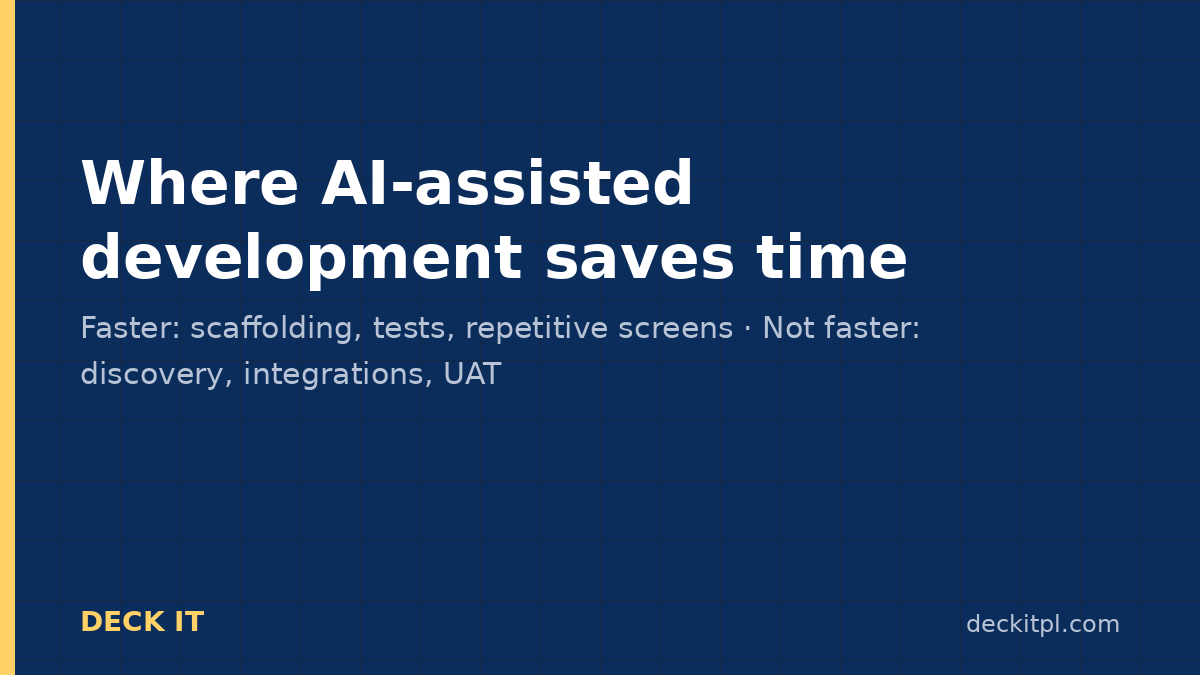
The important phrase is "code-related time". Writing CRUD screens, tests, data migrations and boilerplate gets much faster. Working out what the software should do, agreeing acceptance criteria with the client, connecting to a legacy system with poor documentation, and user acceptance testing do not get faster, because they are bounded by people and conversations, not typing speed.
That is why AI shows up in Indian quotes more as shorter timelines than as dramatically lower prices. A vendor whose team is using AI well can quote a smaller build phase, but discovery, integration and UAT stay roughly the same. The tools themselves are cheap: $500–1,500 a month for a 10-person team (Keyhole Software). If a vendor claims AI cuts their price in half, ask which phases got shorter and by how much.
How to read a quote before you sign it
The cheapest quote is often the one with the most missing. Five questions expose the difference between a fixed price and a low-ball:
- Who tests it? If the developer tests their own work and there is no QA line, budget for the bugs yourself.
- What does "support" include, and for how long? Bug fixes for 30 days is not the same as 12 months of fixes, upgrades and monitoring.
- What happens when I change my mind? Ask for the change-request process and rate before you need it.
- Who owns the code, the repository and the cloud account? They should be in your name from day one.
- Is GST included? Most quotes are ex-GST; a ₹10 lakh quote is ₹11.8 lakh on the invoice (Selyst).
Before asking for quotes at all, write a one-page brief covering the features, platforms, integrations and timeline, get three independent quotes, and hold back 20–25% contingency (Rajesh R Nair). Three quotes against the same brief tell you far more than three quotes against three different conversations.
What we've seen at DECK IT
At DECK IT in Ahmedabad we quote most projects as a fixed price for a defined scope, and most land between ₹5 lakh and ₹40 lakh (roughly $6,000 to $50,000). Small web and mobile apps take 6–8 weeks; larger systems take 3–5 months. We have been doing this since 2017, for clients in India and, through our Newark, Delaware office, in the US, so the numbers above are not a theory to us.
The pattern we see most often is not clients overpaying on rate; it is clients paying twice. A business buys a cheap build, discovers there is no test coverage, no documentation and no one who can be reached, and then pays a second vendor to stabilise or rebuild it. That second bill is why the freelancer and agency rows in the rate table are not really comparable.
AI-assisted development has changed how we work more than what we charge per hour. When we built MedSlay, our AI clinical documentation product for Indian clinics, and MMBtu DESK, our AI platform for India's gas economy, the parts that sped up were exactly the ones the studies describe: scaffolding, tests, repetitive screens. The parts that did not were understanding how a clinic actually runs a consultation and how a gas trader actually prices a cargo. On client projects the same holds, which is why our discovery phase has not shrunk even as our build phases have. If you are budgeting a custom software project, a web application or a mobile app, plan the timeline around the conversations, not the code.
Frequently asked questions
How much does custom software development cost in India?
Custom software development in India costs roughly ₹2 lakh for a small MVP to ₹1 crore or more for an enterprise platform in 2026, with most business applications between ₹5 lakh and ₹25 lakh. Vendors typically quote ₹4–8 lakh for a basic MVP, ₹10–25 lakh for a mid-sized application and ₹25 lakh upwards for ERP-class systems. The final price depends mainly on the number of user roles, integrations, platforms and the depth of design and compliance work.
What is the hourly rate of a software developer in India in 2026?
A mid-level developer at an Indian agency bills $25–45 an hour in 2026; juniors bill $15–25 and seniors $45–80. Blended team rates on a real project are usually $18–40 an hour. Freelancers advertise $8–15 an hour, but that price rarely includes QA, senior review or a replacement if the person leaves.
Why is software development cheaper in India than in the US?
Software development is cheaper in India because salaries and office costs are lower, not because quality is lower. The average Indian software developer earns about ₹7.55 lakh a year against $90,000–150,000 in the US, which is where the 60–70% rate difference comes from. India's technology sector is projected at $315 billion in FY2026 with a workforce of almost 6 million, so mainstream skills are in deep supply.
Fixed price or time and material: which is better?
Fixed price is better when your scope is defined and stable, and time and material is better when you expect requirements to change as you learn. Fixed price gives you a committed scope, timeline and total before work starts, with a risk buffer built in. Many projects use both: fixed price for the defined build and T&M for discovery or later enhancements.
What are the hidden costs of custom software development?
The main costs missing from a headline quote are GST at 18%, cloud hosting and SSL, third-party API and integration fees, and annual maintenance of 15–20% of the build cost. On a ₹10 lakh quote these add up to a first-year total of about ₹13.9–15 lakh. Over the life of the software, roughly 60% of total cost is spent after launch.
Does AI-assisted development make custom software cheaper?
AI-assisted development makes custom software faster to build and modestly cheaper, mainly by shortening the coding and testing phases. Studies report 33–36% less code-related time and up to 55% faster task completion with AI assistants. Discovery, integration with legacy systems and user acceptance testing do not speed up in the same way, so timelines shrink more than prices do.
How long does custom software development take in India?
A basic MVP takes about 6–10 weeks, a mid-sized business platform 4–7 months and an enterprise system 7–14 months in India. At DECK IT, small web and mobile apps take 6–8 weeks and larger systems 3–5 months. The timeline is set as much by how quickly decisions and feedback come from your side as by the development work itself.
Conclusion
If you are budgeting custom software in India this year, start from the ₹5–25 lakh band for a real business application, add 18% GST, hosting, integrations and 15–20% a year for maintenance, and treat anything far below that with suspicion rather than delight. Then write a one-page brief and get three fixed-price quotes against the same document.
If you would like one of those three quotes to come from us, send us the brief. We will tell you what it costs, how long it takes, and what we would leave out of version one.