

ERP implementation cost in India runs from about ₹90,000 for a small business with a few users to ₹15 lakh and more for a mid-sized firm, according to Shivlab. The platform you pick sets the floor, but customisation, the state of your data and how fast your team makes decisions decide where you land.
This guide ranks the factors that move the number, shows what each platform tends to cost, lists the costs that don’t appear in quotes, and ends with a worked first-year budget you can adapt.
Key takeaways
- Indian SME ERP projects are reported at ₹90,000 to ₹15 lakh for 1–50 users (Shivlab).
- ERPNext rollouts are quoted from ₹75,000 for a small two-module setup to ₹5 lakh+ for a 50-user multi-entity one (PS Digitise); SAP Business One implementation starts near ₹20 lakh (Sigzen).
- Customisation, data condition and decision speed move cost more than user count or module count (PS Digitise).
- Industry research puts ERP failure or significant overrun at roughly 50–75% of projects, depending on how failure is defined (Godlan).
How much does ERP implementation cost in India?
For an Indian SME, plan on ₹90,000 to ₹15 lakh for implementation, depending on users, modules and customisation (Shivlab). A typical 20-person firm on a cloud ERP is reported to spend ₹8 to ₹15 lakh in the first year, counting licence, implementation and training (Global Key Infosolution).
Those are published ranges from agencies and partners, not quotes. Treat them as a sanity check on the proposals you receive, and expect a wide spread between a two-module accounting-and-inventory setup and a multi-site manufacturing rollout.
What does ERP implementation cost on each platform?
The platform sets the floor. Open-source options have no licence fee but still need implementation; proprietary options charge per user on top.
| Platform | Reported implementation cost | Licence model | Best for |
|---|---|---|---|
| ERPNext | ₹75,000–₹1.5 lakh (≤15 users); ₹1.5–3 lakh (15–50 users); ₹3–5 lakh+ (50+ users) | Free self-hosted | Small firms with simple flows |
| Odoo | ₹3–25 lakh | ₹800–2,000 per user per month | Growing firms that want modules added over time |
| SAP Business One | From about ₹20 lakh | ₹1.5–3 lakh per user | Larger firms with complex finance and multi-entity needs |
Sources: ERPNext tiers from PS Digitise; Odoo and SAP Business One figures from Sigzen. Vendors revise prices often, so confirm current rates before you budget.
For comparison, a firm that only needs accounting can run TallyPrime Silver at ₹22,500 plus GST for one user (Patron Accounting). That is not an ERP, but it is the baseline an ERP has to beat.
What actually moves the number?
Seven things decide your final cost, listed roughly from biggest to smallest effect.
- Customisation. Every workflow the standard product can’t handle becomes billable development. Indian custom development is quoted at about ₹500 to ₹2,000 an hour (Aurigait), so twenty “small” changes add up fast. Industry research puts customisation at 20–30% of a typical ERP budget (ERP Research).
- Data condition. Cleaning ten years of Tally and Excel files, merging duplicate customers and fixing item codes takes longer than most firms expect. It is one of the most common hidden costs in Indian projects (Sigzen).
- Decision speed. Every week your team takes to approve a screen or sign off a process, the partner’s team is either idle on your bill or moved to another client. Slow decisions also stretch timelines, and timeline overruns of 50–100% are common in ERP projects (Godlan).
- Number of modules and entities. Finance and inventory are cheap to switch on. Manufacturing, multi-branch accounting and multiple GST registrations are not.
- India-specific compliance. GSTIN handling, e-invoicing and complex TDS workflows often need configuration or custom work that overseas templates don’t cover (Sigzen).
- Integrations. Each link to a payment gateway, biometric device, e-commerce store or bank adds scope.
- Users and licences. This matters least for open-source platforms and most for SAP-style per-user pricing.
What are the costs that quotes leave out?
Quotes usually cover the implementation. The costs below tend to arrive afterwards.
- Training. Staff need hands-on sessions, not a one-hour demo. Budget for repeat sessions after go-live.
- Parallel running. Most firms run the old system and the new one side by side for a month or more.
- Post-go-live support. For ERPNext, implementation is reported to be about 60–75% of first-year spend, which leaves 25–40% for hosting and support (Sigzen).
- Hosting and backups. Free software still needs a server and someone to look after it.
- Change requests. Once people use the system, they ask for reports and fields nobody thought of.
Why do ERP projects go over budget?
ERP projects go over budget because scope grows after the contract is signed. Industry sources report that 50–75% of ERP projects fail or overrun significantly, and Gartner predicts that by 2027 more than 70% of recently implemented ERP initiatives will miss their original business-case goals (Godlan).
The cause is rarely the software itself. It is usually a vague scope, a rushed data clean-up, or a team that was never asked how the work actually flows. A fixed-scope first phase with a change-request process protects you from most of this.
A worked first-year budget
This is an illustration, not a quote: a 20-user Indian firm on a mid-priced platform. Replace each line with your own proposal numbers.
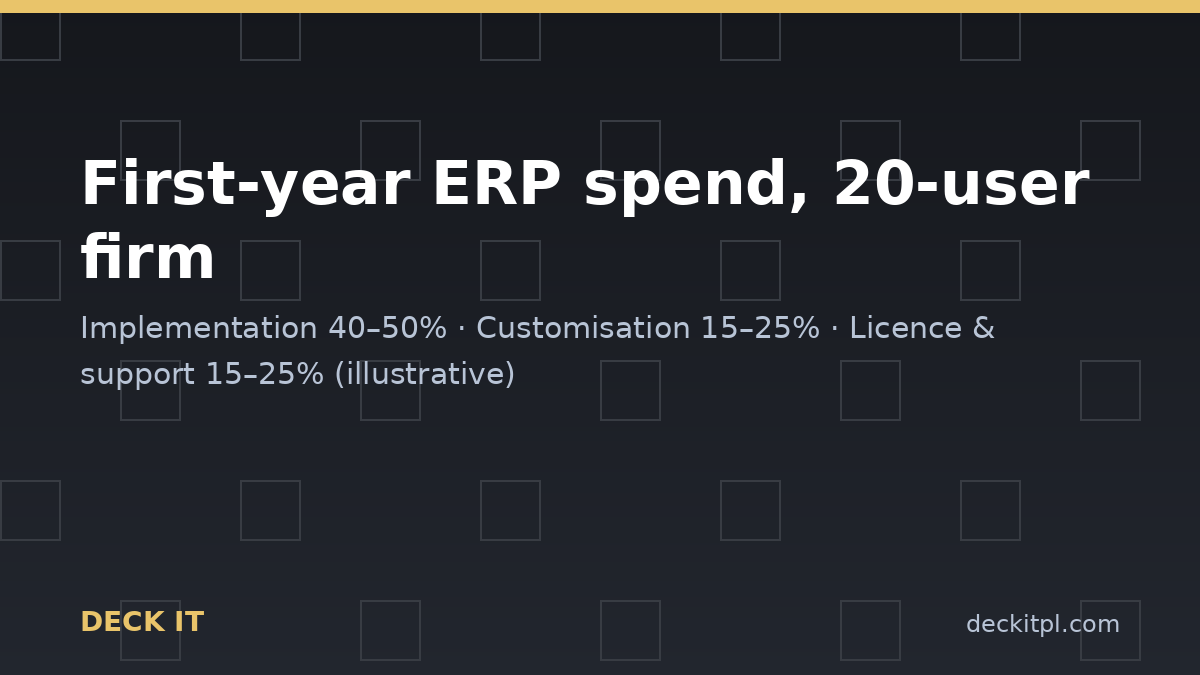
| Line | Share of first-year spend | Why |
|---|---|---|
| Implementation and configuration | 40–50% | Core modules, workflows, reports |
| Customisation | 15–25% | Only the gaps that matter |
| Data migration | 10% | Cleaning and loading |
| Training | 5–10% | Repeated sessions |
| Licence, hosting and support | 15–25% | Recurring from month one |
| Contingency | 10% | For scope that appears later |
The shares above are our planning rule of thumb, not a published benchmark. Against the reported ₹8–15 lakh first-year range for a 20-person firm, they give you a way to see which line in a quote looks too thin or too fat.
How do you keep the cost down without cutting corners?
Start smaller than you think you need. These five habits cut cost without cutting the outcome.
- Launch with finance, inventory and sales; add other modules after the first quarter.
- Change your process before you change the software. Customise only where the process is how you make money.
- Clean your data before the project starts, not during it.
- Name one person who can approve decisions in a day.
- Ask every vendor for a fixed-scope first phase and a written change-request rate.
If your process is unusual enough that no ERP fits, the choice changes. Our guide to custom software vs off-the-shelf walks through that decision, and our custom software development cost guide covers what a build costs.
What we’ve seen at DECK IT
DECK IT is an Ahmedabad software company founded in 2017, and we build business systems for Indian firms. A common trap is comparing platform prices and giving very little time to scope. The platform is the visible number; scope, data and decisions are the ones that grow.
Our advice is to spend the first week on a written list of the workflows you run today, marked as “must keep”, “can change” and “can drop”. That list is the best defence against both overpaying and under-scoping. If you want a second opinion on a quote, our ERP consulting and implementation team can review it.
Frequently asked questions
How much does ERP implementation cost for a small business in India?
Expect roughly ₹90,000 to ₹15 lakh, depending on users, modules and customisation. Small ERPNext setups with two or three modules are quoted from ₹75,000 to ₹1.5 lakh. Get written quotes, because the spread between vendors is wide.
Which is cheaper, ERPNext, Odoo or SAP Business One?
ERPNext is usually the cheapest to implement and has no licence fee when self-hosted. Odoo sits in the middle with per-user subscriptions. SAP Business One costs the most, with per-user licences of ₹1.5–3 lakh and implementations from about ₹20 lakh.
Why do ERP projects exceed their budget?
Scope grows after signing, data is messier than expected, and decisions arrive late. Industry research reports that 50–75% of ERP projects fail or overrun significantly. A fixed-scope first phase and a change-request rate reduce the risk.
What are the hidden costs of ERP implementation?
The most common are data migration, training, parallel running, post-go-live support and India-specific compliance work such as GST and TDS. Ask your vendor to price each of these separately.
How long does ERP implementation take?
A small two-to-three-module rollout often takes weeks, while multi-site or manufacturing projects take months. Timeline overruns of 50–100% are common, so add buffer to any date a vendor gives you.
Is customising an ERP worth it?
Customise only where your process gives you an edge. Everywhere else, change the process to fit the software, because every customisation adds development cost and slows future upgrades.
Conclusion
Compare quotes on scope, not on the platform price. Write down your workflows, clean your data, fix a first phase, and ask for a change-request rate in writing. Then the number you are quoted is close to the number you will pay.
If you want help scoping an ERP or checking a quote you’ve received, talk to DECK IT.
Last updated: